Fine-Tuning vs. RAG: Choosing the Right Large Language Model Strategy for Enterprise Data
Enterprise AI adoption is accelerating, but deploying Large Language Models (LLMs) securely over proprietary data remains a challenge. This guide breaks down the architectural, cost, and accuracy trade-offs between Fine-Tuning and Retrieval-Augmented Generation (RAG).
“When enterprises attempt to leverage Large Language Models (LLMs) on their proprietary data, they immediately face an architectural crossroads: Should we fine-tune a model, or build a Retrieval-Augmented Generation (RAG) pipeline? While both approaches aim to bridge the gap between general AI knowledge and domain-specific context, their implementation, cost, and maintenance profiles are vastly different. At Rubrich Technologies, we have engineered both systems for enterprise clients. This comprehensive analysis will equip CTOs and AI architects with the framework needed to select the right approach for their specific data ecosystem.”
Understanding the Core Mechanics
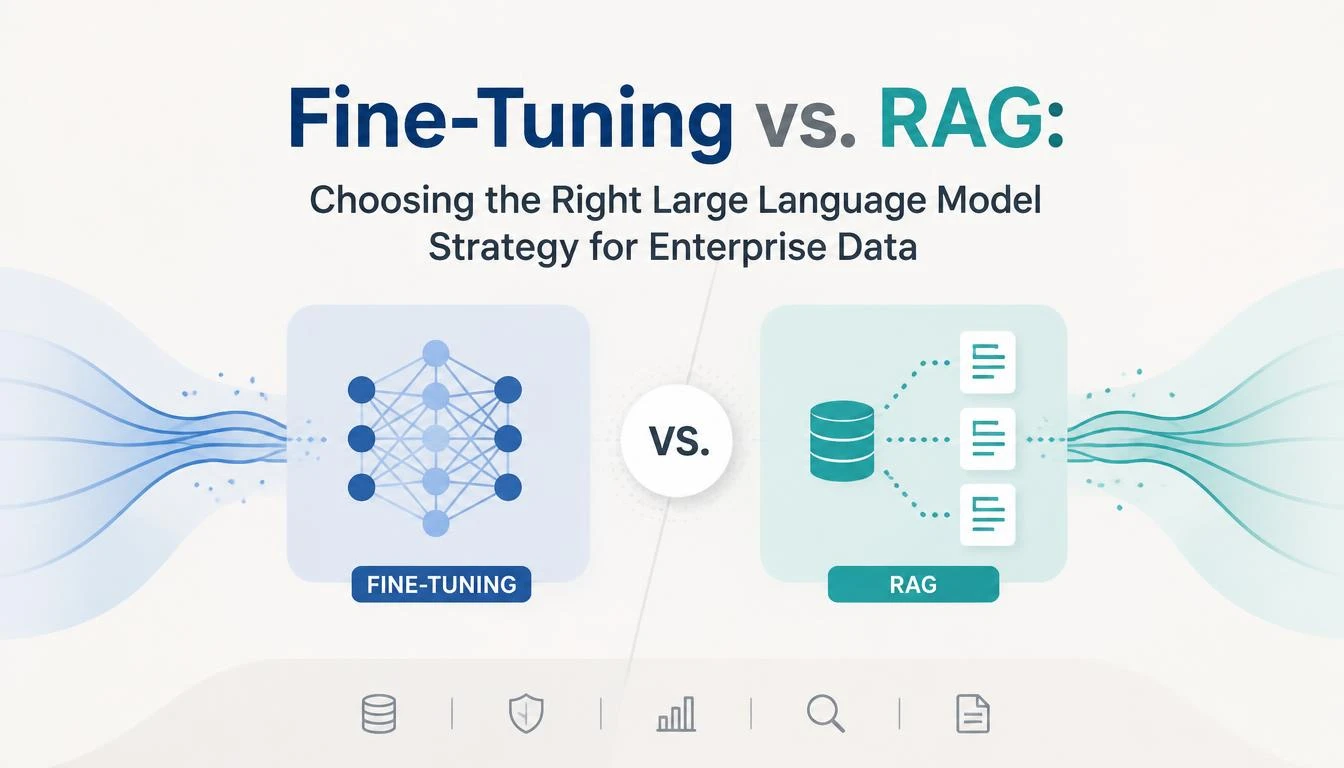
To make an informed decision, it is critical to understand how each strategy manipulates AI context. Fine-tuning involves taking a pre-trained foundational model (like Llama 3 or Mistral) and updating its internal weights by training it on thousands of proprietary examples. It fundamentally alters the 'brain' of the model to learn a specific style, tone, or highly specialized vocabulary.
Retrieval-Augmented Generation (RAG), on the other hand, leaves the foundational model's weights entirely untouched. Instead, it acts as an intelligent librarian. When a user asks a question, the RAG system first queries a vector database (containing the enterprise's secure documents) to find relevant information. It then injects that specific information directly into the prompt before sending it to the LLM. The AI is essentially answering the question while reading a highly relevant cheat sheet.
The Case for Retrieval-Augmented Generation (RAG)
For over 80% of enterprise use cases, RAG is the superior architectural choice. The primary advantage of RAG is data freshness and absolute source traceability. Because the model relies on a real-time database lookup rather than its internal memory, you can trace every generated answer back to a specific PDF, Confluence page, or database row.
Furthermore, RAG eliminates the massive computational overhead associated with training. If a company policy changes, you simply update the document in the vector database. In a fine-tuned model, updating knowledge requires entirely retraining the model, which is costly and slow.
Technical Takeaways
When Fine-Tuning is the Only Option
If RAG is so effective, when should an enterprise invest in fine-tuning? Fine-tuning is required when you need to teach the model a new language, a highly complex syntactical structure, or a specific behavioral tone that cannot be explained in a standard prompt.
For example, if you are building an AI agent to write medical triage reports in a highly specific, standardized shorthand used only by your hospital network, RAG will not suffice. You need the model's fundamental output structure to change. Fine-tuning excels at 'Form,' whereas RAG excels at 'Fact.'
Technical Takeaways
The Hybrid Architecture: RAG-Fusion and PEFT
The most advanced enterprise architectures in 2026 do not choose between the two—they combine them. The state-of-the-art approach involves Parameter-Efficient Fine-Tuning (PEFT) combined with an advanced RAG pipeline.
In this hybrid model, a smaller, cost-effective LLM is fine-tuned to understand the specific jargon and query intent of the enterprise. This fine-tuned model is then hooked into a RAG pipeline to retrieve factual data. This delivers the behavioral accuracy of fine-tuning alongside the factual reliability and security of RAG. Rubrich Technologies specializes in designing and deploying these hybrid AI ecosystems, ensuring our clients achieve maximum ROI on their AI infrastructure.