Next.js 16 Server Components vs. Traditional SSR: Maximizing Core Web Vitals for E-Commerce
Discover how transitioning from traditional SSR to Next.js 16 Server Components can slash your JavaScript payload by 60%, drastically improving LCP, CLS, and INP metrics for high-traffic E-Commerce storefronts.
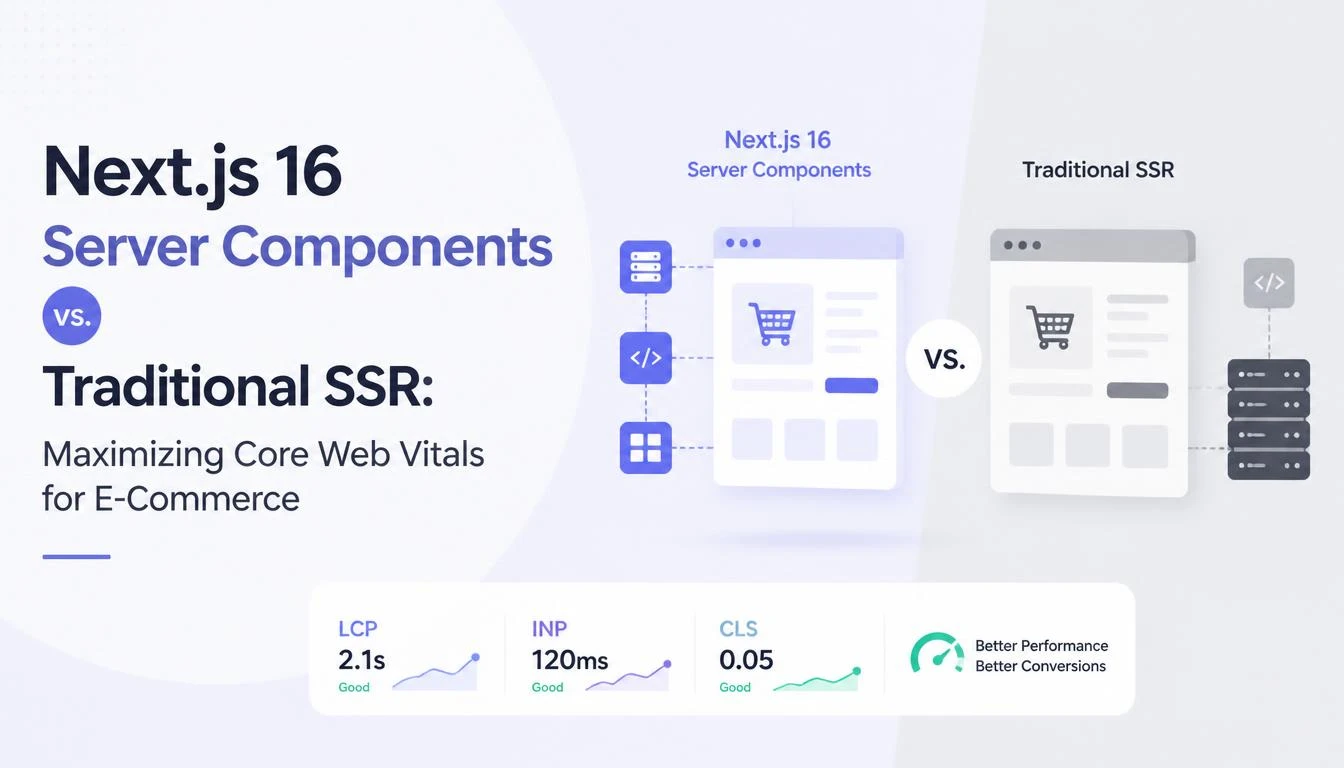
“Discover how transitioning from traditional SSR to Next.js 16 Server Components can slash your JavaScript payload by 60%, drastically improving LCP, CLS, and INP metrics for high-traffic E-Commerce storefronts.”
The Evolution of Rendering in Modern E-Commerce
For years, Server-Side Rendering (SSR) via `getServerSideProps` was the golden standard for building dynamic, SEO-friendly e-commerce storefronts. It solved the blank-page problem of Single Page Applications (SPAs) by delivering fully populated HTML to the browser. However, traditional SSR comes with a hidden cost: Hydration. When a traditional SSR page loads, the browser downloads the HTML, but it also has to download, parse, and execute the entire React component tree in JavaScript just to attach event listeners (hydration). For a heavy e-commerce site loaded with carousels, product variants, and complex navigations, this hydration phase blocks the main thread, tanking your Interaction to Next Paint (INP) and frustrating users on mobile devices. Enter React Server Components (RSC) in Next.js 16.
What are React Server Components?
Server Components introduce a fundamental paradigm shift. Instead of sending all React components to the client to be hydrated, Server Components execute exclusively on the server. They render into a special binary format, which Next.js streams to the browser. The browser then paints the UI without ever needing to download the JavaScript that generated it. This means you can import massive formatting libraries (like `date-fns`), complex markdown parsers, or direct database SDKs into a Server Component, and zero bytes of those dependencies will be sent to the user's browser.
The Problem with Traditional SSR for E-Commerce
E-commerce websites are notoriously difficult to optimize because they require a perfect balance of dynamic data (live inventory, personalized recommendations, cart state) and instantaneous load times. 1. The Payload Bloat In traditional Next.js SSR (Pages Router), if your product page requires a 50KB library to format a complex technical specification table, that 50KB library is bundled into the client-side JavaScript. The user's device has to download and execute it, even though the table is completely static after the initial render. 2. The Waterfall Effect SSR forces a "waterfall" approach. The server must finish fetching all data for the page before it can begin sending any HTML to the browser. If your inventory API takes 800ms to respond, the user stares at a white screen for 800ms. 3. Hydration Bottlenecks Once the HTML arrives, the browser must hydrate the entire page. During this time, the main thread is locked. If a user tries to tap the "Add to Cart" button while the page is hydrating, the browser cannot respond, leading to poor INP (Interaction to Next Paint) scores—a metric Google now heavily weights for SEO.
How Next.js 16 Server Components Solve the Core Web Vitals Crisis
By default, all components in the Next.js App Router are Server Components. You must explicitly opt-in to client-side interactivity using the `'use client'` directive. This inversion of control forces developers to think critically about where JavaScript is actually needed. 1. Slashing Largest Contentful Paint (LCP) Because Server Components do not send JavaScript to the client, the initial HTML payload is drastically smaller. The browser can parse the DOM and paint the Largest Contentful Paint (often the product hero image) significantly faster. Furthermore, Next.js 16 supports Streaming with Suspense. Instead of waiting for all data to load, the server can instantly stream the static header and product skeleton to the browser, while the slower inventory data streams in chunks as it resolves. 2. Eradicating Cumulative Layout Shift (CLS) E-commerce sites often suffer from CLS when client-side `useEffect` hooks fetch data and inject it into the DOM after the initial render, pushing content down. Server Components fetch data natively on the server. The UI is constructed with its exact dimensions before it reaches the browser, completely eliminating layout shifts. 3. Optimizing Interaction to Next Paint (INP) This is where Server Components truly shine. By isolating interactivity to specific "islands" (e.g., the Add to Cart button, the image gallery slider), you reduce the hydration tree from the entire page down to a few micro-components. When the main thread isn't choked by hydrating a massive footer and static product description, it is immediately available to respond to user input. The "Add to Cart" button responds instantly, resulting in elite INP scores.
The "Buy for Commodity, Build for Differentiator" Framework in E-Commerce
When migrating a legacy monolithic e-commerce platform to a Next.js 16 architecture, CTOs often face the build-vs-buy dilemma for various services. The Server Component architecture natively supports a composable, headless approach. You can "Buy" commodity services:
And "Build" your differentiators:
Strategic Implementation: The Island Architecture
To maximize the benefits of Next.js 16, e-commerce teams should adopt the Island Architecture. 1. The Ocean (Server Components): The overarching layout, headers, footers, static product descriptions, reviews, and related product grids should all be Server Components. They fetch data securely on the server and output pure, zero-JS HTML. 2. The Islands (Client Components): Only the specific interactive elements—the variant selector, the quantity toggle, the image carousel, and the cart drawer—should be marked with `'use client'`. This architecture ensures that the JavaScript bundle sent to the user is incredibly lean, containing only the logic necessary for interactive features.
Security Implications
Traditional SSR often required setting up proxy API routes to securely fetch data from protected microservices, adding latency and complexity. Server Components run securely on the server. You can safely instantiate database connections, use secret API keys, and query sensitive data directly inside the component body, completely bypassing the need for a middleman API route.
Conclusion: The Future is Server-First
The transition from traditional SSR to Next.js 16 Server Components is not just a framework upgrade; it is a fundamental architectural shift that aligns perfectly with the strict demands of Core Web Vitals. For enterprise e-commerce platforms where a 100ms delay can cost millions in revenue, adopting a server-first architecture is no longer optional—it is a competitive necessity.