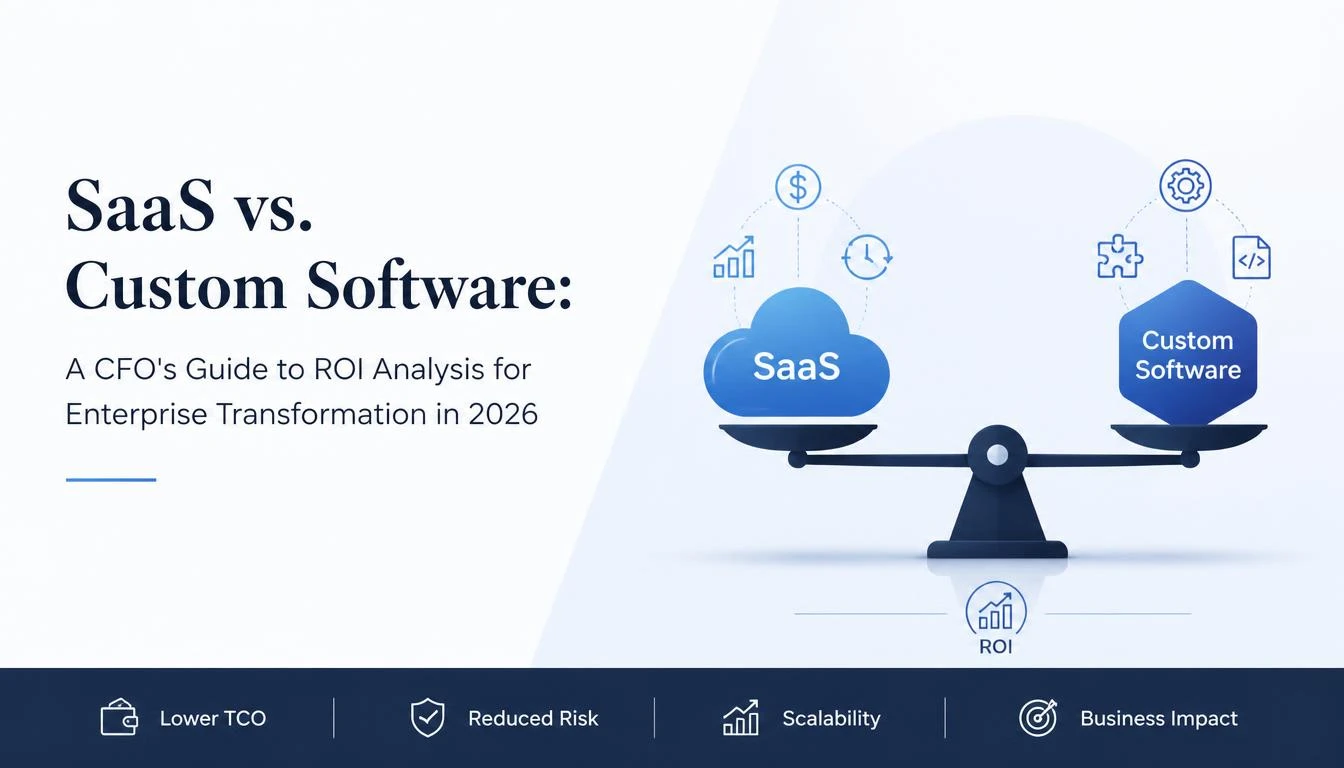
SaaS vs. Custom Software: A CFO's Guide to ROI Analysis for Enterprise Transformation in 2026
When should an enterprise buy a SaaS subscription versus building custom software? A deep financial analysis of ROI, data sovereignty, and scalable architecture.
“When should an enterprise buy a SaaS subscription versus building custom software? A deep financial analysis of ROI, data sovereignty, and scalable architecture.”
The Illusion of Cheap SaaS
For modern enterprises, the initial appeal of Software as a Service (SaaS) is undeniable. Low upfront costs, instant deployment, and zero server maintenance make it highly attractive to CTOs and CFOs alike. Why spend $100,000 building a custom CRM when you can subscribe to Salesforce for $150 per user per month?
However, as businesses scale, the SaaS model often reveals a hidden, compounding financial trap. When a mid-sized enterprise scales from 50 to 500 employees, that $150/user/month suddenly balloons into a $900,000 annual recurring expense.
This guide analyzes the critical inflection points where renting software becomes a catastrophic financial leak, and when investing in proprietary, custom-built architecture generates massive long-term ROI.
1. The 3-Year Total Cost of Ownership (TCO) Crossover
Financial modeling consistently shows a 'Crossover Point' between SaaS and Custom Software, typically occurring between month 24 and month 36 for mid-to-large enterprises.
Building a custom enterprise application requires a significant CapEx (Capital Expenditure) upfront—paying for business analysts, developers, and UI/UX designers. During the first two years, the custom route is undeniably more expensive.
But by year three, the custom software requires only marginal maintenance and hosting fees (OpEx). Meanwhile, the SaaS platform continues to extract massive licensing fees, which inevitably increase as the provider raises prices or the business adds more seats. Over a 5-to-10 year horizon, custom software is mathematically cheaper.
2. Data Sovereignty and Vendor Lock-In
In 2026, data is the most valuable asset on a company's balance sheet. When you rely entirely on an external SaaS provider for core operations, you are renting your own data infrastructure. If the SaaS provider changes their API structure, gets acquired by a competitor, or suffers a catastrophic security breach, your business is entirely at their mercy.
Custom software guarantees absolute Data Sovereignty. The enterprise owns the source code, the database architecture, and the intellectual property. This is particularly critical in heavily regulated industries like finance, healthcare, and defense manufacturing, where compliance mandates strict control over data residency.
3. The Competitive Advantage of Unique Processes
SaaS platforms are, by definition, built for the masses. They force your business to conform to their generalized workflows. If your enterprise has a highly specialized supply chain process that gives you a competitive edge, trying to shoehorn that process into a generic SaaS tool will inevitably erode that advantage.
Custom software is molded precisely to your operations. It automates your specific bottlenecks, integrates natively with your legacy machinery, and provides features that your competitors simply cannot buy off the shelf.
Conclusion: Buy the Utility, Build the Core
The modern consensus for enterprise architecture is pragmatic: 'Buy the Utility, Build the Core.'
If a software system handles a non-differentiating utility (e.g., employee payroll or basic email), buy a SaaS subscription. But if the software handles the core mechanics of how you deliver value to your customers—your manufacturing pipeline, your proprietary trading algorithms, or your unique customer portal—you must build and own it.