Why Your AI Agent Keeps Hallucinating: A Guide to Data Grounding for Enterprise RAG Pipelines
Hallucination isn't a model flaw you can prompt your way out of. It's a data architecture problem. Here's how enterprises are grounding AI agents in verified context to make them production-safe in 2026.
“Hallucination isn't a model flaw you can prompt your way out of. It's a data architecture problem. Here's how enterprises are grounding AI agents in verified context to make them production-safe in 2026.”
The Hallucination Problem Isn't Going Away
Gartner projects that by the end of 2026, roughly forty percent of enterprise applications will include task-specific AI agents, up from under five percent just two years earlier. That speed of adoption has outpaced a much harder problem enterprises still haven't solved: agents that confidently state incorrect information, invent data that doesn't exist, or misquote internal policy documents in ways that look entirely plausible to a non-expert reviewer.
Most engineering teams' first instinct is to fix hallucination through prompting, adding instructions like 'only answer based on verified facts' or 'do not make up information.' This almost never works reliably, because hallucination is not a behavioral quirk that better instructions can override. It is a structural consequence of how large language models generate text: they predict statistically likely next tokens, not verified facts, and no amount of prompt engineering changes that underlying generation mechanism.
The teams that have actually solved hallucination at production scale didn't do it by writing better prompts. They did it by re-architecting how the agent accesses information in the first place, a discipline now broadly known as data grounding.
Why Hallucinations Happen: A Root Cause Breakdown
An ungrounded AI agent answers every question the same way: it retrieves patterns from its training data and generates the most statistically probable continuation. When a question falls within well-represented, stable knowledge, this works well. When a question touches your company's specific pricing structure, a policy updated last month, a customer's individual order history, or a niche technical specification, the model has no reliable internal reference for the correct answer, but it will still generate a fluent, confident-sounding response regardless.
This gets significantly worse in multi-agent systems, where one agent's ungrounded output becomes the next agent's input. If a planning agent misinterprets a customer's order status and passes that incorrect assumption to an execution agent, the execution agent has no way of knowing the input was wrong; it simply acts on it. Enterprises deploying coordinated, multi-agent workflows are now seeing this 'hallucination cascade' as one of the leading causes of costly automation failures.
The root cause, in every case, is the same: the agent is reasoning over its training data or its own prior output instead of reasoning over verified, current, source-of-truth information. Grounding exists specifically to close that gap.
What 'Grounding' Actually Means in Production Systems
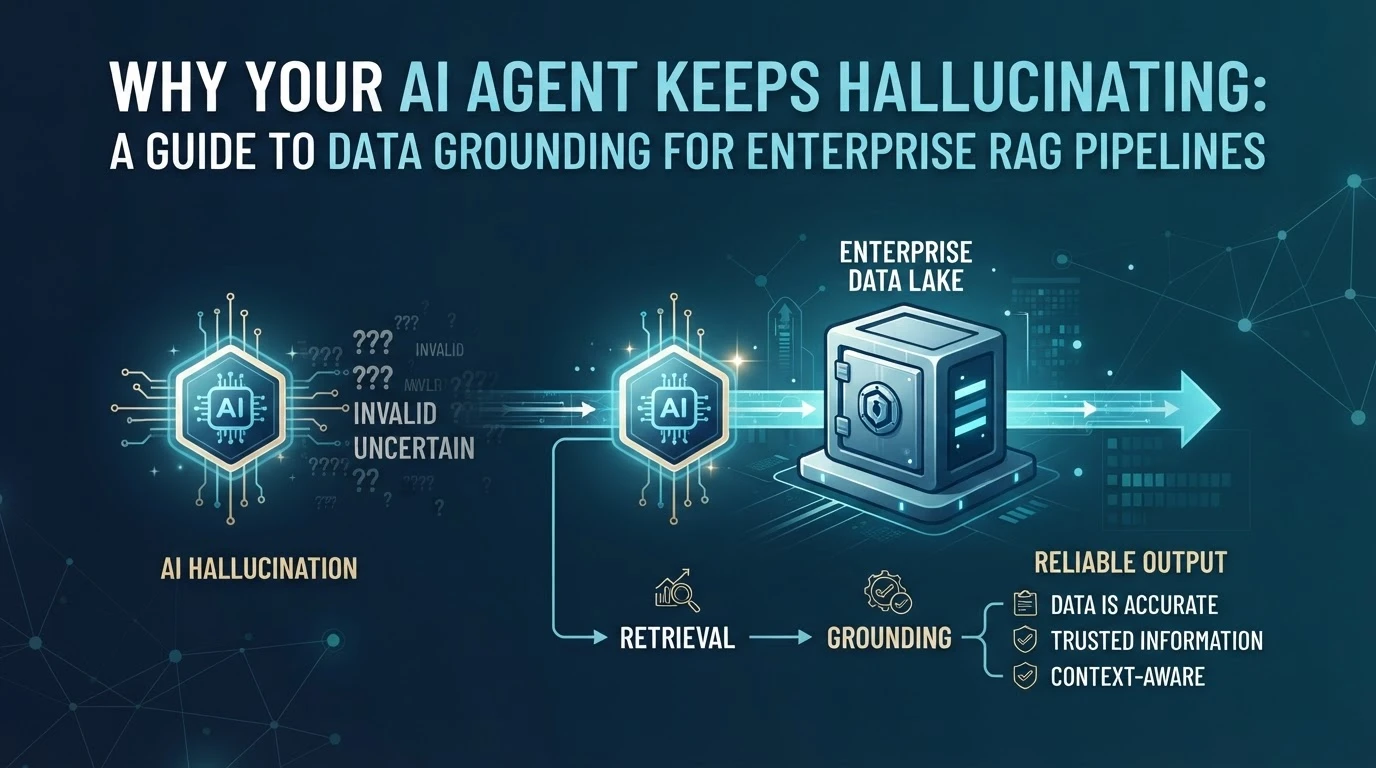
Data grounding is the practice of forcibly connecting an AI agent's reasoning process to verified, external, and current data sources, rather than allowing it to answer from its static internal training. In practice, this typically means Retrieval-Augmented Generation, where the agent retrieves specific, relevant passages from your actual CRM records, ERP data, policy documents, or product database before generating any response, and is explicitly instructed to answer only from that retrieved content.
Effective grounding is not a single technical trick; it is a pipeline. Raw enterprise data, whether it lives in a CRM, a document repository, a ticketing system, or application logs, must be cleaned, chunked, embedded into a vector representation, indexed for fast retrieval, and continuously refreshed as the underlying source data changes. An agent grounded against a database that was last synced six months ago will confidently deliver outdated information with exactly the same fluency it would deliver correct information.
The distinguishing feature of a well-grounded system is traceability. A properly grounded agent should be able to cite precisely which document, record, or data field it drew its answer from, allowing a human reviewer to instantly verify the claim rather than simply trusting the agent's tone of confidence.
Building a Grounding Pipeline: From Raw Data to Verified Context
The first stage of any grounding pipeline is source consolidation: identifying every system of record the agent needs to reason over, whether that's Salesforce, an internal SharePoint, a ticketing platform, or structured SQL databases, and establishing reliable, permissioned access to each one. Enterprises frequently underestimate this stage, treating it as a simple integration task when it actually requires careful data governance decisions about what an agent should and should not be allowed to see.
The second stage is chunking and embedding: breaking documents and records into semantically coherent segments and converting them into vector embeddings that a retrieval system can search efficiently. Poor chunking, splitting a policy document mid-sentence or mid-table, is a surprisingly common and underrated cause of grounding failures, since the agent ends up retrieving fragments that are technically relevant but contextually incomplete.
The third stage is retrieval logic itself: determining how the agent decides what to fetch, how many results to pull, and how to handle cases where the retrieved context genuinely does not contain an answer. A well-designed grounded agent should be explicitly capable of saying 'I don't have verified information on this' rather than falling back on its ungrounded training knowledge when retrieval comes up empty, a behavior that has to be deliberately engineered rather than assumed.
Real-Time vs. Static Grounding: Choosing the Right Architecture
Not all enterprise data needs the same grounding architecture. Static grounding, where a knowledge base is indexed periodically, such as nightly or weekly, works well for relatively stable information like product documentation, HR policy, or training material, where the cost of a real-time connection outweighs the benefit.
Real-time grounding, by contrast, connects the agent directly to live systems, querying a CRM or inventory database at the moment of the request rather than relying on a pre-indexed snapshot. This is essential for any agent handling customer-facing tasks involving current order status, live inventory levels, or account-specific financial data, where even a few hours of staleness produces answers that are technically hallucinated relative to present reality, even if they were accurate yesterday.
Most mature enterprise deployments in 2026 use a hybrid model: real-time grounding for volatile, transaction-critical data, and static, periodically refreshed grounding for stable reference material, balancing system latency and infrastructure cost against the accuracy requirements of each specific use case.
Measuring Success: Groundedness Metrics Enterprises Should Track
Enterprises that treat grounding seriously don't just deploy it once and assume it works; they measure it continuously. Groundedness scoring, evaluating whether a given agent response is fully supported by its retrieved source material, is now a standard evaluation layer in mature AI deployments, often implemented as an automated secondary check that flags any response containing claims not traceable to retrieved context.
Retrieval precision and recall are equally important: precision measures whether the content the agent retrieved was actually relevant, while recall measures whether the retrieval system found all the relevant content available. A system with poor recall will produce grounded but incomplete answers, technically accurate yet dangerously partial, particularly in compliance-sensitive domains like financial reporting or medical documentation.
Finally, staleness monitoring, tracking the gap between when source data changes and when the agent's indexed knowledge reflects that change, is essential for any system handling operationally current information. Enterprises that skip this monitoring layer often discover grounding failures only after a customer or auditor catches an outdated answer, which is precisely the expensive, reputation-damaging scenario grounding was meant to prevent in the first place.
Conclusion
Hallucination is not a temporary limitation that the next model release will quietly solve; it is an architectural reality of how generative models work, and it only becomes safe to deploy at enterprise scale once it is addressed at the data layer, not the prompt layer. A properly grounded AI agent, connected to verified, current, and traceable enterprise data through a well-engineered RAG pipeline, transforms from an impressive but unreliable demo into a genuinely production-ready system your teams and customers can actually trust.