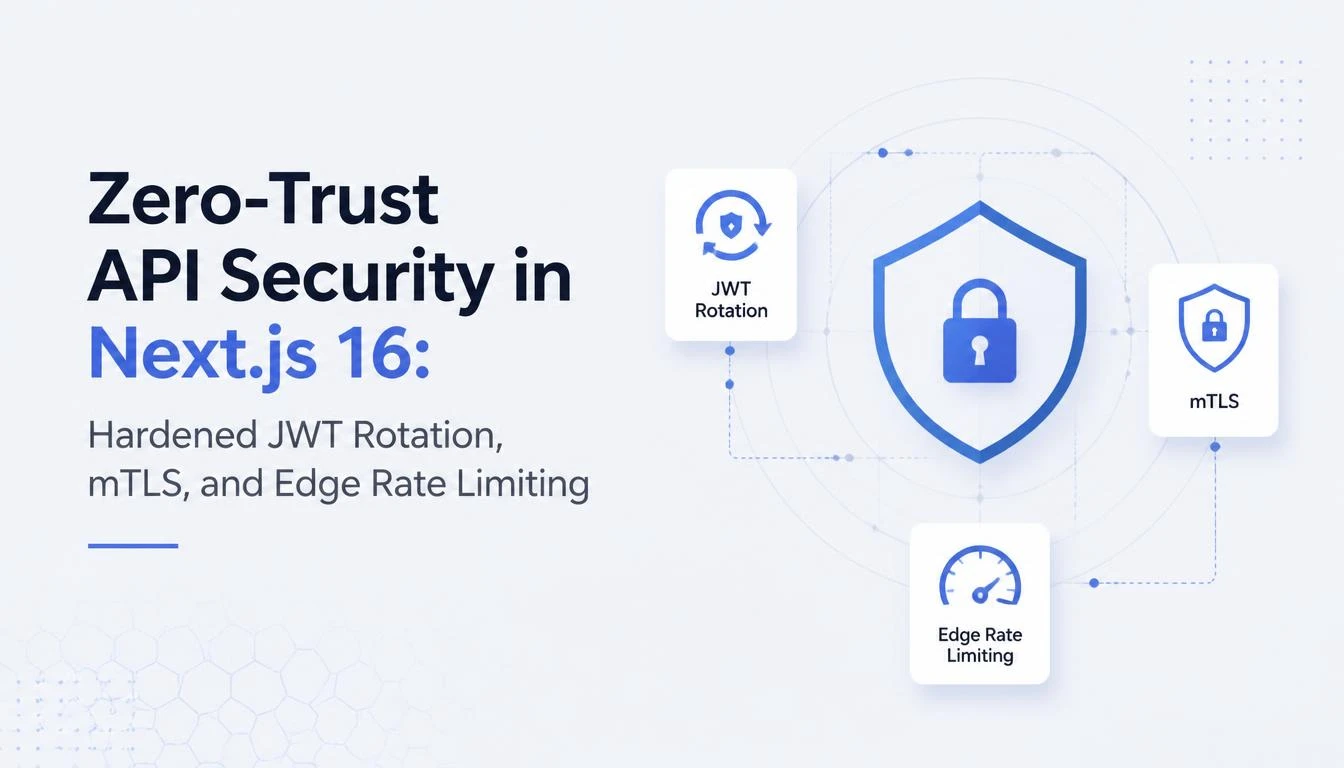
Zero-Trust API Security in Next.js 16: Hardened JWT Rotation, mTLS, and Edge Rate Limiting
A production-grade DevSecOps blueprint for implementing Zero-Trust API security in Next.js 16. Master short-lived JWT refresh token rotation, Token Family Fingerprinting, mTLS service-to-service transport encryption, and Edge rate limiting.
“Traditional perimeter-based cybersecurity cannot protect modern hybrid Next.js 16 applications from lateral exploitation. This comprehensive technical guide provides security architects and senior full-stack developers with a battle-tested blueprint for implementing Zero-Trust security across the Next.js runtime. We examine cryptographic refresh token rotation, token family replay detection, defense-in-depth authorization beyond middleware, Mutual TLS (mTLS) with X.509 certificates, and edge-level token-bucket rate limiting via Upstash Redis.”
The Death of the Perimeter: Why Modern Next.js Applications Demand Zero Trust
In the software architecture landscape of 2026, the traditional 'castle-and-moat' cybersecurity model is officially dead. Historically, enterprise web applications relied on fortified network boundaries: corporate VPNs, private VPC subnets, and reverse-proxy firewalls designed to keep malicious actors outside the perimeter while assuming that all internal traffic inside the network was benign. However, the rise of hybrid-cloud infrastructures, distributed microservice meshes, third-party SaaS integrations, and serverless edge runtimes has obliterated the concept of a trusted internal network. Once an attacker compromises a single vulnerable dependency, an unauthenticated internal microservice, or an employee credential, a perimeter-based security model allows unfettered lateral movement across the entire enterprise stack.
Nowhere is this paradigm shift more acute than in modern Next.js 16 applications. Next.js bridges client-side single-page reactivity with server-side execution through React Server Components (RSC), Server Actions, and Route Handlers. Because Next.js server code frequently executes within multi-tenant serverless nodes or cloud containers with direct network access to private databases and internal microservices, treating the frontend server as an inherently trusted bastion is a catastrophic mistake. If an attacker injects a cross-site scripting (XSS) payload or exploits an unauthenticated Server Action, they gain an immediate springboard into the enterprise backend.
The antidote to this systemic vulnerability is Zero Trust Architecture (ZTA). Defined by the foundational doctrine 'Never Trust, Always Verify', Zero Trust mandates that every single request—whether initiated by an end-user clicking a button in a browser, a background job triggering a webhook, or a Next.js server proxying an internal microservice—must be cryptographically authenticated, authorized with least-privilege granularity, and subjected to continuous behavioral inspection across every hop.
Hardened JWT Architecture: Eliminating Long-Lived Tokens with Cryptographic Rotation
JSON Web Tokens (JWTs) remain the de facto industry standard for stateless authentication in modern web systems, yet naive JWT implementations account for an alarming percentage of modern enterprise data breaches. The most pervasive architectural blunder is the deployment of long-lived access tokens (e.g., tokens valid for 24 hours, 7 days, or 30 days) stored directly in browser localStorage or sessionStorage. In a browser environment, any client-side JavaScript execution—including code originating from compromised npm dependencies, third-party analytics tags, or DOM-based XSS—can inspect localStorage, exfiltrate the token, and grant attackers indefinite, undetectable access to user accounts without triggering security alerts.
A hardened, zero-trust JWT architecture mandates an aggressive dual-token lifecycle strategy: short-lived access tokens combined with cryptographically rotated refresh tokens.
Access tokens must have an ultra-short time-to-live (TTL), typically between 5 and 15 minutes. These tokens are signed using asymmetric cryptography (e.g., Ed25519 or RSA-256 with private/public key pairs) rather than symmetric shared secrets (HMAC-SHA256). Asymmetric key signing ensures that downstream microservices only require access to the public key (distributed via a secure JWKS endpoint) to verify token integrity, completely eliminating the catastrophic risk of leaking the signing secret across disparate microservice codebases. Each token must also contain standard cryptographic claims: issuer (iss), audience (aud), expiration time (exp), and not before (nbf) to prevent cross-service token substitution.
Refresh tokens, meanwhile, must have an operational lifespan of several days but must be subjected to strict Refresh Token Rotation (RTR). Under RTR, whenever a client transmits a refresh token to the authentication endpoint to obtain a new 15-minute access token, the authentication server immediately invalidates the consumed refresh token and issues a brand-new, cryptographically random refresh token. Both tokens must be transported exclusively via HttpOnly, Secure, and SameSite=Strict cookies. By enforcing the HttpOnly flag, client-side JavaScript is physically barred from accessing token bytes via the document.cookie API, neutralizing XSS exfiltration vectors entirely.
To counter token theft scenarios where an attacker intercepts an in-flight refresh token, enterprise systems must implement Token Family Fingerprinting. Every refresh token is minted with a persistent 'familyId' and a sequential 'generationId'. If the authentication server ever receives a refresh token that has already been consumed (a classic replay signature indicating that both the legitimate user and a threat actor possess the token), the server immediately triggers an intrusion alert and revokes the entire token family. This instantly terminates all active sessions associated with that user account, thwarting session hijacking in real time.
In Next.js 16 Route Handlers, developers can implement an automatic silent refresh pattern. When a Server Action or Route Handler detects that an access token has expired within its 15-minute window, it seamlessly reads the HttpOnly refresh token cookie, invokes the rotation transaction against the auth server, updates the response cookies with the new token pair, and executes the business logic without subjecting the end-user to frustrating login interruptions.
Defense-in-Depth Authorization: The Fallacy of Middleware-Only Security
A dangerous anti-pattern observed across enterprise Next.js codebases is the over-reliance on Next.js middleware.js as the sole gatekeeper for application security. While Next.js middleware is exceptionally powerful for performing fast, edge-level routing checks, URL rewrites, and preliminary cookie inspections, relying on middleware alone to enforce business-level authorization creates critical security blind spots.
Next.js middleware operates at the network routing boundary before the request hits the server execution context. Because middleware runs on lightweight edge runtimes, it frequently lacks direct access to persistent database connections, complex role-based access control (RBAC) graphs, or distributed permission caches. Furthermore, complex routing configurations, dynamic parameter matching, and internal Next.js asset rewrites can lead to route matching misses where a developer inadvertently leaves a nested route handler unprotected.
Crucially, Next.js 16 Server Actions represent isolated remote procedure call (RPC) endpoints. An attacker can reverse-engineer the POST request payload transmitted by a Server Action and invoke the underlying action directly via HTTP, bypassing standard visual UI guards. If the Server Action does not independently verify authentication and granular permissions within its own execution block, the application becomes vulnerable to Insecure Direct Object References (IDOR) and broken object-level authorization (BOLA).
In a robust Zero-Trust Next.js architecture, defense-in-depth requires a three-tier validation pipeline: (1) Edge Middleware performs coarse-grained validation—verifying the presence and cryptographic signature of the session cookie, rejecting unauthenticated traffic before compute resources are consumed. (2) Route Handlers and Server Actions perform fine-grained domain authorization—decoding user claims, querying the authorization engine, and verifying that the authenticated user explicitly owns the requested resource ID. (3) Strict Schema Validation—every inbound request body, query parameter, and server action argument must be validated using runtime schema libraries like Zod. Enforcing strict schema parsing strips unexpected fields, prevents prototype pollution, and guarantees that malformed payloads fail immediately with clean validation errors.
Mutual TLS (mTLS): Cryptographic Zero-Trust for Service-to-Service Communication
While user-facing authentication secures traffic entering the Next.js frontend, an enterprise architecture is only as secure as the internal communication between the Next.js server and downstream microservices (such as payments, inventory, AI inference, and database APIs). In traditional setups, inter-service traffic is often left unencrypted or protected only by basic API keys transmitted across internal VPC subnets. If an attacker achieves container breakout or accesses a shared cloud network, they can sniff unencrypted payloads or forge internal requests.
Mutual TLS (mTLS) extends zero-trust security to the transport layer. In standard one-way TLS, the client verifies the identity of the server via an X.509 digital certificate, and traffic is encrypted. In Mutual TLS, both parties must cryptographically authenticate each other. The downstream microservice presents its certificate to Next.js, and the Next.js server must present its own client certificate signed by a trusted internal Private Certificate Authority (pCA). If either certificate is invalid, expired, or signed by an unrecognized CA, the TLS handshake is aborted at the transport layer before any application bytes or HTTP headers are parsed.
Implementing mTLS in enterprise Next.js microservices involves two primary architectural patterns: (1) Service Mesh Sidecars: In Kubernetes or containerized enterprise environments, mTLS is abstracted away from application code using service meshes like Istio, Linkerd, or Envoy sidecars. The Envoy proxy handles bidirectional certificate validation, traffic encryption, and mTLS handshakes transparently on localhost. (2) Native HTTPS Client Configuration: For Next.js backends communicating directly with external microservices, Node.js HTTPS agents can be configured with dedicated client certificates and private keys: new https.Agent({ cert: fs.readFileSync('client-cert.pem'), key: fs.readFileSync('client-key.pem'), ca: fs.readFileSync('ca-chain.pem'), rejectUnauthorized: true }).
To prevent operational outages caused by expired certificates, enterprise architectures implement automated certificate lifecycle management using systems like SPIFFE/SPIRE or HashiCorp Vault. These systems dynamically issue ephemeral X.509 SVIDs (SPIFFE Verifiable Identity Documents) with short lifespans (e.g., 1 hour), rotating certificates seamlessly in the background without requiring application restarts or manual operator intervention.
Edge Rate Limiting & Distributed Abuse Mitigation
In a Zero-Trust paradigm, availability is an essential pillar of security. High-throughput enterprise backends must withstand malicious credential stuffing attacks, automated vulnerability scanners, bot scraping, and DDoS attempts without degrading performance for legitimate enterprise users. Deploying rate limiting inside downstream monolithic databases or deep inside business logic is inefficient, as compute-heavy Node.js worker threads must parse and process requests before determining whether to reject them.
The state-of-the-art solution in Next.js 16 is Edge-Level Rate Limiting implemented directly within Next.js Middleware. By inspecting requests at edge points-of-presence (PoPs) globally, anomalous traffic bursts are throttled in sub-2 milliseconds before packets ever touch internal backend clusters.
The industry-standard architectural implementation combines Next.js Middleware with globally distributed, ultra-low-latency in-memory datastores such as Upstash Redis utilizing the Sliding Window Counter or Token Bucket algorithms. Unlike naive fixed-window rate limiters—which suffer from boundary bursting vulnerabilities where an attacker sends twice the rate limit at the turn of an hour—sliding window algorithms evaluate request frequency across continuous rolling time intervals, delivering deterministic mathematical throttling.
A hardened enterprise rate-limiting topology applies multi-tiered policies based on identity context: (1) Anonymous IP Throttling: Unauthenticated public endpoints (such as login forms, password resets, and marketing lead submissions) are constrained to strict thresholds (e.g., 5 requests per minute per IP address) to stop brute-force credential stuffing. (2) Authenticated User Rate Limiting: Once a request presents a valid JWT session, rate limiting shifts from tracking dynamic IP addresses (which can change or be shared via NAT proxies) to tracking the authenticated user ID (sub claim). Premium enterprise tiers can be granted elevated concurrency thresholds (e.g., 1,000 requests per minute) while standard users are throttled at lower levels.
Furthermore, edge middleware must emit standardized IETF rate-limiting headers with every response: X-RateLimit-Limit, X-RateLimit-Remaining, and X-RateLimit-Reset. When a client exceeds their allowance, the edge immediately terminates the connection with an HTTP 429 Too Many Requests response, appending a Retry-After header, shielding downstream systems from resource starvation.
The OWASP API Security Top 10 Hardening Checklist for Next.js 16
To ensure complete regulatory compliance and audit-ready resilience, engineering teams can benchmark their Next.js 16 deployments against this production security checklist:
- Broken Object Level Authorization (BOLA/IDOR): Verify that every Route Handler and Server Action validates that req.user.id equals resource.ownerId. Never trust client-supplied entity IDs without verifying ownership.
- Broken Authentication: Enforce short-lived (15-min) access tokens with automated refresh token rotation. Store tokens strictly in HttpOnly, Secure, SameSite=Strict cookies. Implement Token Family Fingerprinting to detect session replay.
- Broken Object Property Level Authorization: Eliminate mass-assignment vulnerabilities by validating all request payloads with strict Zod schemas, automatically stripping unlisted or privileged fields such as isAdmin or userRole.
- Unrestricted Resource Consumption: Enforce Edge-level rate limiting using Upstash/Redis on all Route Handlers and Server Actions. Enforce maximum payload size limits to prevent memory exhaustion attacks.
- Security Misconfiguration: Configure hardened HTTP security response headers in next.config.mjs or middleware: Content-Security-Policy (CSP), Strict-Transport-Security (HSTS), X-Content-Type-Options: nosniff, and X-Frame-Options: SAMEORIGIN.
- Server-Side Request Forgery (SSRF): Sanitize and validate all external URLs fetched by Next.js Server Components. Disallow requests to private internal IP ranges (127.0.0.1, 10.0.0.0/8, 192.168.0.0/16, and cloud metadata IP 169.254.169.254).
By systematically adopting this Zero-Trust framework, enterprise engineering teams can deploy Next.js 16 full-stack applications that withstand sophisticated cyberattacks, protect sensitive client data, and guarantee continuous, unbroken business operations across 2026 and beyond.