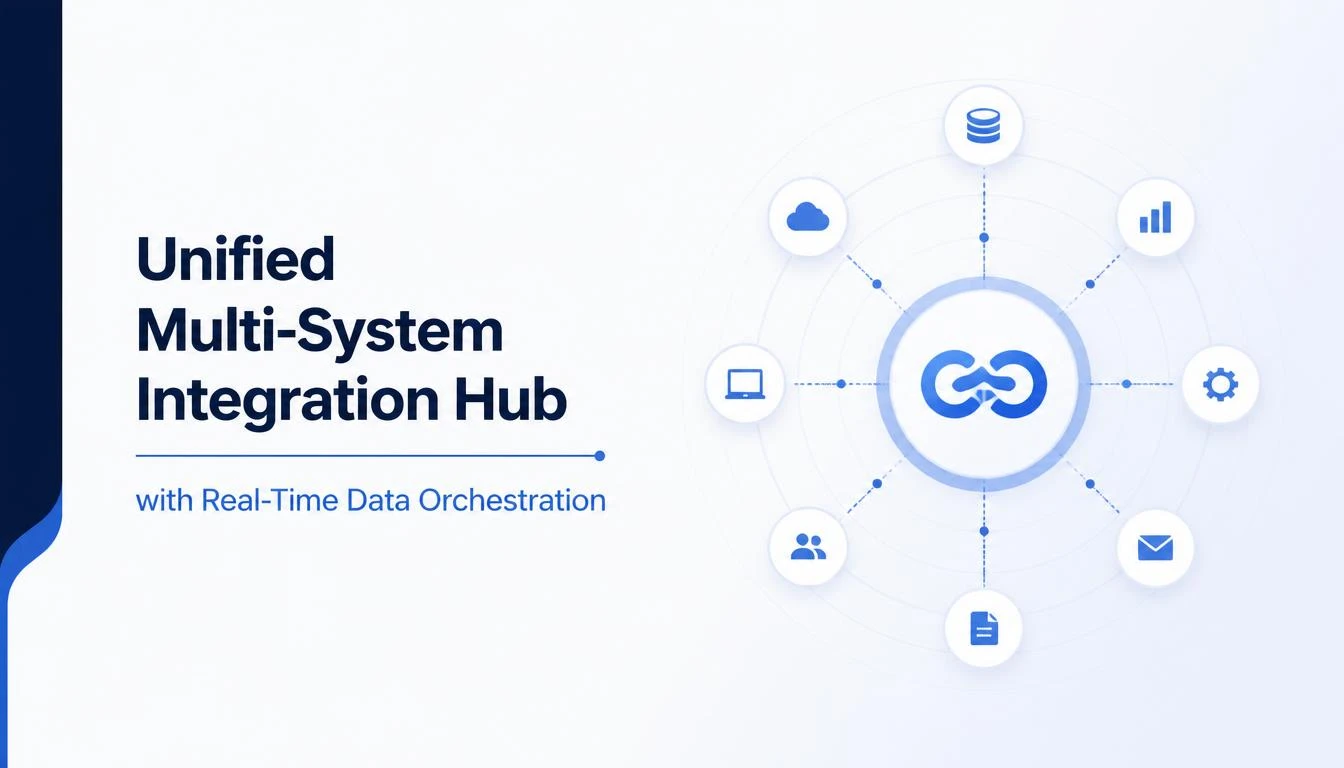
Unified Multi-System Integration Hub with Real-Time Data Orchestration
An enterprise data orchestration platform that acts as a centralized nervous system connecting disparate business systems, enabling real-time bidirectional data sync, intelligent conflict resolution, and automated audit trails.
Detailed Project Overview
OrchestraFlow is a next-generation enterprise integration platform (EIP) built to eliminate data silos and manual reconciliation across mission-critical systems. In traditional enterprises, data flows in all directions—POS systems talk to inventory, which talks to finance, which talks to e-commerce—but they rarely speak to each other without manual intervention. This creates a cascading nightmare: inventory discrepancies, billing errors, delayed shipments, and teams wasting 40% of their time manually reconciling data across spreadsheets.
OrchestraFlow is the centralized nervous system that solves this. Built on Node.js, Apache Kafka, and GraphQL, it connects any enterprise system (ERP, CRM, inventory, finance, logistics, billing, compliance, e-commerce platforms) and orchestrates real-time, bidirectional data flow. The platform doesn't just move data from A to B—it intelligently transforms, validates, and resolves conflicts at scale.
At its core, OrchestraFlow employs a hybrid architecture: Apache Kafka handles high-volume event streaming for real-time sync (orders, shipments, payments), while GraphQL federation provides a unified query layer for complex, cross-system data joins. A sophisticated conflict resolution engine uses deterministic rules and machine learning to handle edge cases: when an order quantity differs between systems, the engine applies business logic (trust the ERP, defer to fulfillment center, or escalate to human review) and maintains an immutable audit trail of every decision.
The platform includes pre-built connectors for 50+ enterprise systems (SAP, Oracle NetSuite, Salesforce, Shopify, QuickBooks, Stripe, Twilio, and custom APIs), reducing implementation time from months to weeks. A React + Next.js dashboard provides real-time visibility into data flow health, integration latency, error rates, and reconciliation status. Webhook-based event handling, exponential backoff retry logic, and dead-letter queues ensure data never gets lost, even during system outages.
Tools & Technologies
The Objective
To transform enterprise data architecture from fragmented, error-prone silos into a unified, self-healing nervous system—eliminating manual reconciliation, reducing operational costs by 35%, and enabling real-time business decisions across all departments.
Key Features
- Real-Time Event Streaming: Apache Kafka-powered bidirectional sync across unlimited enterprise systems with sub-second latency.
- Intelligent Conflict Resolution: Deterministic rule engine + ML-assisted decision-making for resolving data discrepancies without manual intervention.
- Pre-Built System Connectors: 50+ ready-to-deploy integrations for ERP (SAP, Oracle NetSuite), CRM (Salesforce), e-commerce (Shopify), payments (Stripe), and custom APIs.
- GraphQL Federation Layer: Unified query interface enabling complex cross-system data joins and real-time aggregations without ETL complexity.
- Data Transformation Pipeline: Visual, code-free flow designer for mapping, filtering, aggregating, and enriching data across systems.
- Immutable Audit Trail: Complete event history and decision logs for compliance, forensics, and reconciliation verification.
- Automatic Conflict Escalation: Smart routing of unresolvable conflicts to appropriate human teams with context and recommendations.
- Dead-Letter Queue Management: Guaranteed message delivery with exponential backoff retry logic, preventing data loss during outages.
- Real-Time Monitoring Dashboard: Visualization of integration health, latency metrics, error rates, and data flow topology across all connected systems.
- Webhook & Event Notification: Configurable webhooks and Slack/email alerts for critical integration failures or anomalies.
- Data Governance & Compliance: Field-level encryption, role-based access control, and compliance reporting for GDPR, HIPAA, SOC 2.
- Horizontal Scalability: Kubernetes-native deployment supporting 1M+ events/second with auto-scaling based on throughput.
Advanced Methodologies
Implementation Workflow
Project Outcomes
Ready to Start Your Project?
Partner with Rubrich Technologies for mission-critical deployments in enterprise software and research analytics.